
EU 🚚 available via DHL
A sunlit hotel facade with framed plantings, photographed from the entrance.

YUMA for hospitality professionals

Six touchpoints one coherent scent direction

The entrance, lobby, and guest room do not need three disconnected scent choices. They need one direction, calibrated intensity, and the right product format for each touchpoint. Follow the journey, then request the hospitality catalogue.

Follow the journey

Scent connects the different moments of a stay

Guests do not separate the entrance, lobby, and room into independent experiences. They experience one stay. When scent changes at random from one touchpoint to the next, the experience loses coherence. When the same scent direction returns at an intensity and in a format suited to each space, the stay gains continuity and character. Research into multisensory hospitality design approaches the experience as a whole: scent, light, sound, materials, and human interaction working together.
Charles Spence, Frontiers in Psychology, 2022
Stone hotel at sunset, with illuminated windows and the sea on the horizon.

Arrival

The first impression begins before the front desk.

Before seeing the room, the guest has already crossed the entrance and reception area. That is where the first impression of care begins to form. Give this opening moment a consistent scent character instead of leaving it to be defined by cleaning products, food, or outside air.
Research on guest experience and memory suggests that the beginning, end, and strongest moments of an experience can carry more weight in what remains in memory. Arrival therefore deserves to be designed as a whole, with scent framing the welcome, lighting, and pace of the space.
Charles Spence, Frontiers in Psychology, 2022

Recommended approach

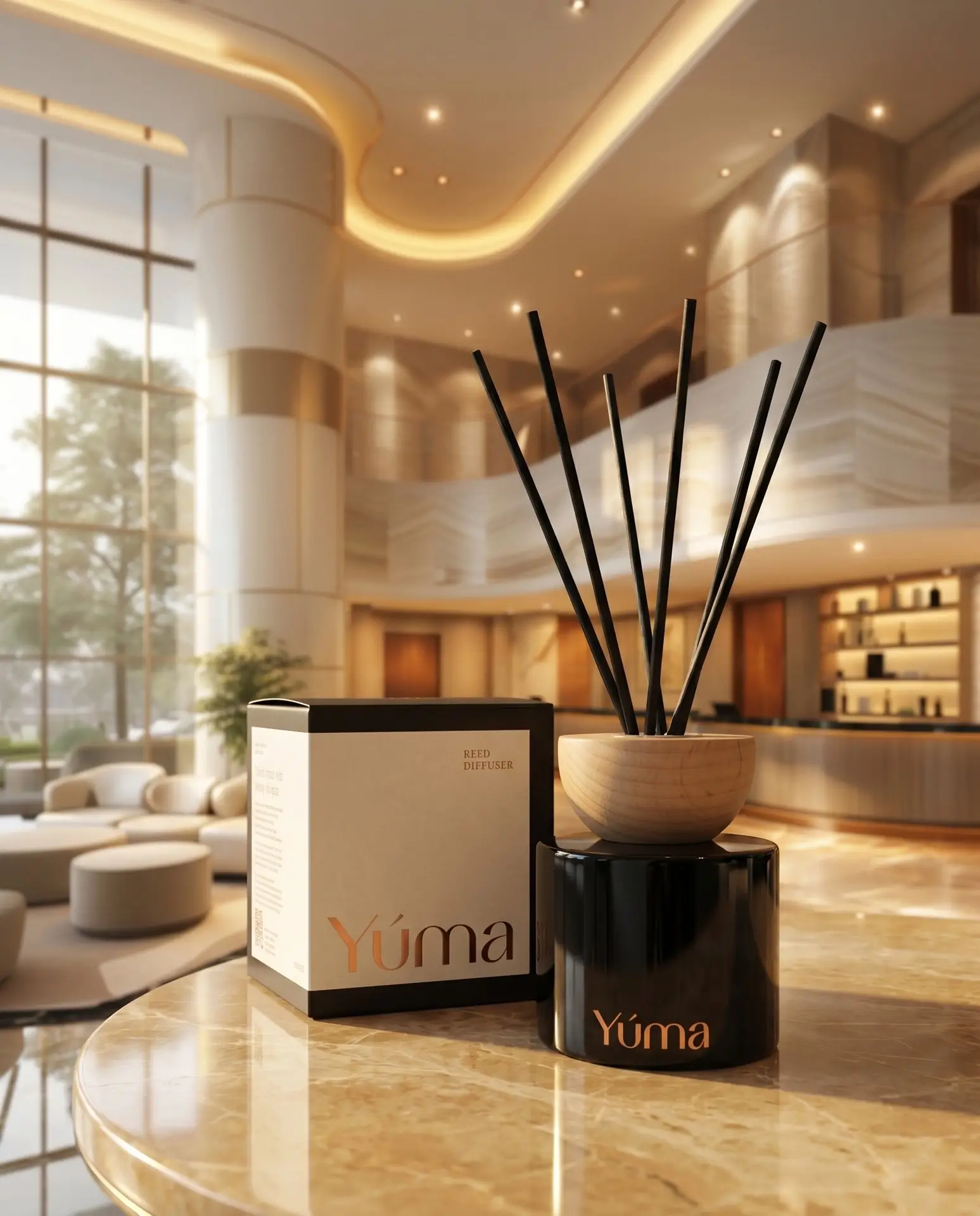
Start with one controlled indoor point near the entrance. A Reed Diffuser maintains a steady scent presence without repeated application. Choose a scent family from the catalogue that suits the property character, then test its intensity during real arrival traffic.

A practical starting point for hotels, resorts, villas, and smaller properties.

Application exampleA bright coastal property might begin with a fresh or citrus direction. A mountain or more traditional setting might trial woody or warmer profiles.
Atmospheric, dark hotel corridor with twin sconces on the walls and a heavy wooden door.

Threshold

The entrance and lobby should belong to the same story.

If the entrance feels cool and clean but the lobby switches abruptly to a heavy gourmand profile, the story breaks between the two spaces. Continuity comes from one scent family and controlled intensity, not from using the same amount of product everywhere.
In a field experiment in a real store, consumer responses were more positive when the scent was perceived as congruent with the brand image than under weak-congruence or no-scent conditions. The useful hospitality principle is fit: the scent should belong to the property, not merely smell pleasant in isolation.
Errajaa et al., Journal of Retailing and Consumer Services, 2020

Recommended format

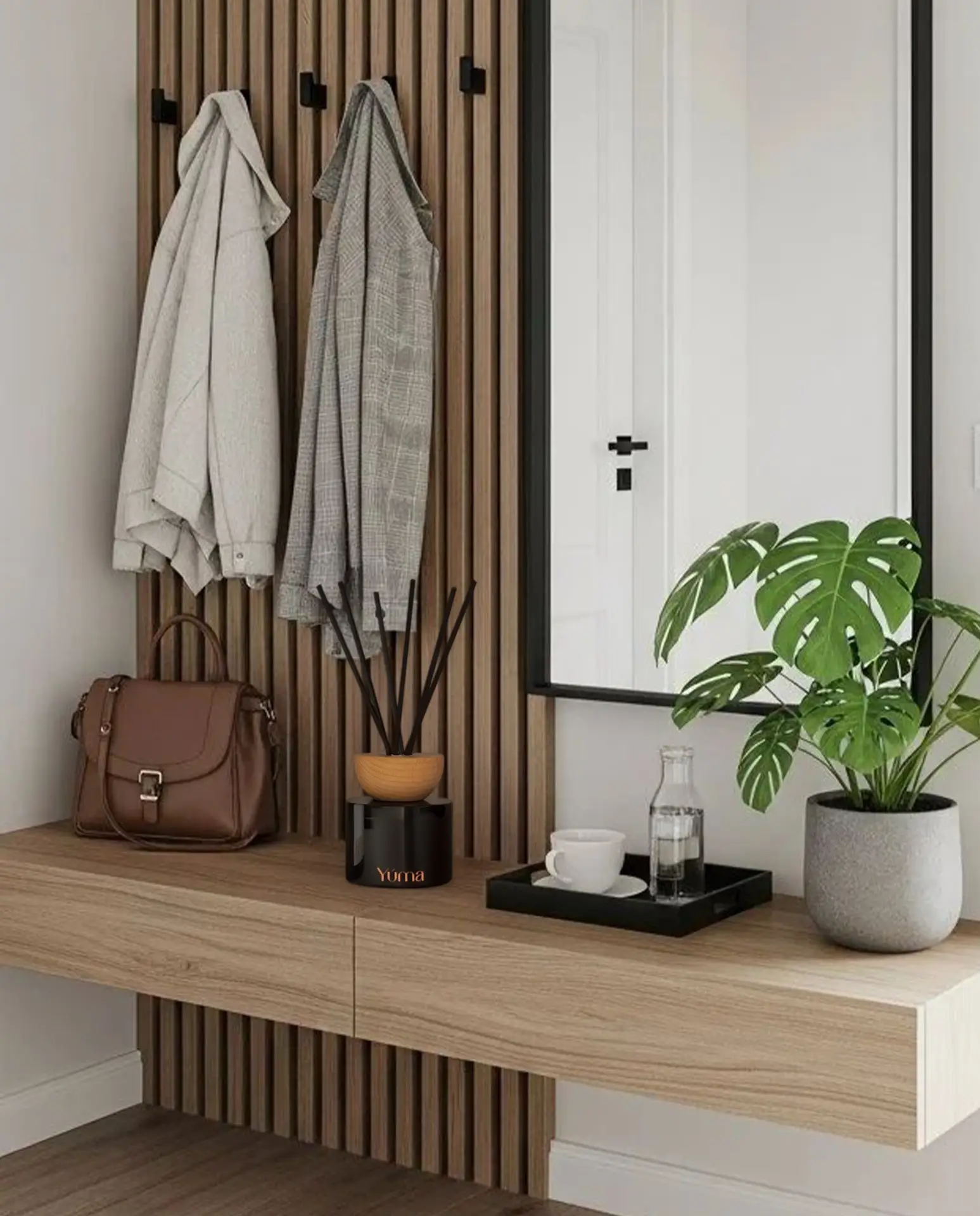
Keep the same scent family from the entrance into the lobby. Place a Reed Diffuser in a protected position that does not obstruct traffic. If you use Fabric Mist, apply it only to textiles named in the product instructions and test an inconspicuous area first.

For properties of any size, adjusted for entrance airflow and guest traffic.

Application exampleWhen the lobby follows directly from the entrance, adjust intensity through placement or the number of fixed scent points without changing scent family.

Spacious, wood-clad hotel lounge with a bookcase, low leather sofas, and a panoramic view.

Lobby

More intensity does not create a better atmosphere.

Arrivals, waiting, breakfast, meetings, and evening traffic change the character of a lobby throughout the day. Map its zones and operating hours so scent remains distinctly present without overwhelming food service or becoming too strong in areas where guests stay longer.
Continuous exposure to an odour quickly reduces its perceived intensity. Staff who spend hours in the same space can therefore underestimate how strong it feels to someone who has just entered. An assessment after leaving and re-entering is more useful than a judgement made after hours of continuous exposure.
Smeets & Dijksterhuis, Frontiers in Psychology, 2014

Recommended composition

Use Reed Diffusers as fixed scent points and Fabric Mist for controlled refreshes only where its instructions allow. Assess intensity after re-entering the space and ask more than one member of the team before increasing the scent presence.

Adapted to lobby layout, ventilation, traffic, and operating hours.

Application exampleIn a lobby connected to a breakfast or dining area, keep fixed scent points away from tables and the service station.

Hotel room with a curved wooden headboard, pendant light, and neatly made white sheets.

Room

In the guest room, control matters as much as continuity.

In the guest room, the scent choice becomes personal. Housekeeping needs clear steps, and guests need a clear option when they prefer no added fragrance. A considered programme remains coherent while respecting each guest’s preference.
In a field experiment across retail and service settings, advance information led to more favourable evaluations of ambient scenting. For a guest room, the practical principle is transparency and choice: staff know exactly what is in use, while the property can respond promptly to a request for no added fragrance.
Gottschalk et al., International Journal of Retail & Distribution Management, 2018

Recommended room programme

Use Fabric Mist as a controlled refresh only on textiles listed in the instructions. A Reed Diffuser can be added when there is a stable, protected position and a clear removal process. Keep the same scent family as the public areas when that option is available in the catalogue.

For rooms with a consistent application process and a clear no-added-fragrance option.

Application exampleRecord the product, permitted textiles, placement, and removal procedure in the housekeeping brief so every shift follows the same method.

Hotel bathroom clad in book-matched marble, with a white freestanding tub and a dark floor.

Bathroom

Scent completes the impression of care.

In the bathroom, the impression of care begins with what guests see and sense at first glance. A considered scent presence completes that picture. Scent strengthens the impression of a well-kept space, while ventilation, damp, and maintenance remain part of its overall care.
Spence’s review cites studies in which a citrus scent made a space appear cleaner and was associated with less mess. Applied to a bathroom, the principle becomes a discreet scent finish that complements the visible standard of care.
Charles Spence, Frontiers in Psychology, 2022

Recommended bathroom programme

Place a Reed Diffuser in a stable, protected position, or use Fabric Mist only on textiles allowed by its instructions. Trial fresh, citrus, or gentle floral directions at an intensity suited to the smaller space.

For bathrooms with a consistent preparation process and adequate ventilation.

Application exampleWhen the bathroom opens directly into the room, keep the same scent family and trial a more discreet presence.

A stack of vintage leather suitcases with brass locks, bathed in warm afternoon light.

Departure

Give guests a scent they will recognise.

A generic gift begins and ends at reception. A product in the same scent family as the property brings a familiar part of the stay into the guest’s home. The familiar scent becomes a link to the place without relying on a heavy corporate message.
In an experimental study, odour cues evoked autobiographical memories that were more emotional and evocative than visual or auditory versions of the same cues. For a departure gift, the practical lesson is to choose a familiar scent the guest has already encountered during the stay.
Rachel Herz, Chemical Senses, 2004

Recommended departure gift

Choose Fabric Mist, Wax Tablet, or Candle from the hospitality catalogue and keep the same scent direction as the guest room. The final format depends on budget, order volume, transport, and how the gift will be presented.

For hospitality programmes with a defined budget per gift.

Application exampleThe product can be reserved for selected bookings or included in a defined package so the cost per departure remains predictable.

The rollout

Four decisions to make before calculating quantities

To turn the idea into a clear quantity proposal, decide what remains consistent and what changes by touchpoint. Products and quantities can then serve one coherent programme rather than a series of unrelated purchases.
01One shared scent direction
Choose one core family that fits the property character. Intensity and format can change by touchpoint without losing continuity across the stay.
02One clear role for each format
Define where you need a fixed presence, a controlled refresh, or a departure product. Each format is selected for its specific role, not simply because it appears in the catalogue.
03One method for the whole team
Record who checks intensity, when each touchpoint is refreshed, and how staff handle a request for no added fragrance. Consistency depends on a process that every shift can follow.
04One property trial
Test the direction under real airflow, traffic, and operating conditions before a wider rollout. A property trial shows where placement, format, or intensity needs to change.

What the approved catalogue shows

  • Categories and products currently available to hospitality businesses
  • Current scent options and product-specific information
  • Ex-VAT prices and the minimum quantity for each category
  • Volume tiers calculated from the total quantity within a category
  • A product list submitted as a quote request before any order is placed

Map the scent journey through your property

Map the*scent journey*~through your property~
Tell us your property type and room count. Those two details establish the initial scale of the programme and direct you to the hospitality catalogue.

Professional Catalog Application

Enter your business details. If you would like a call, choose a date and time in the form.

Applying does not place an order or commit you to a purchase.

Request access